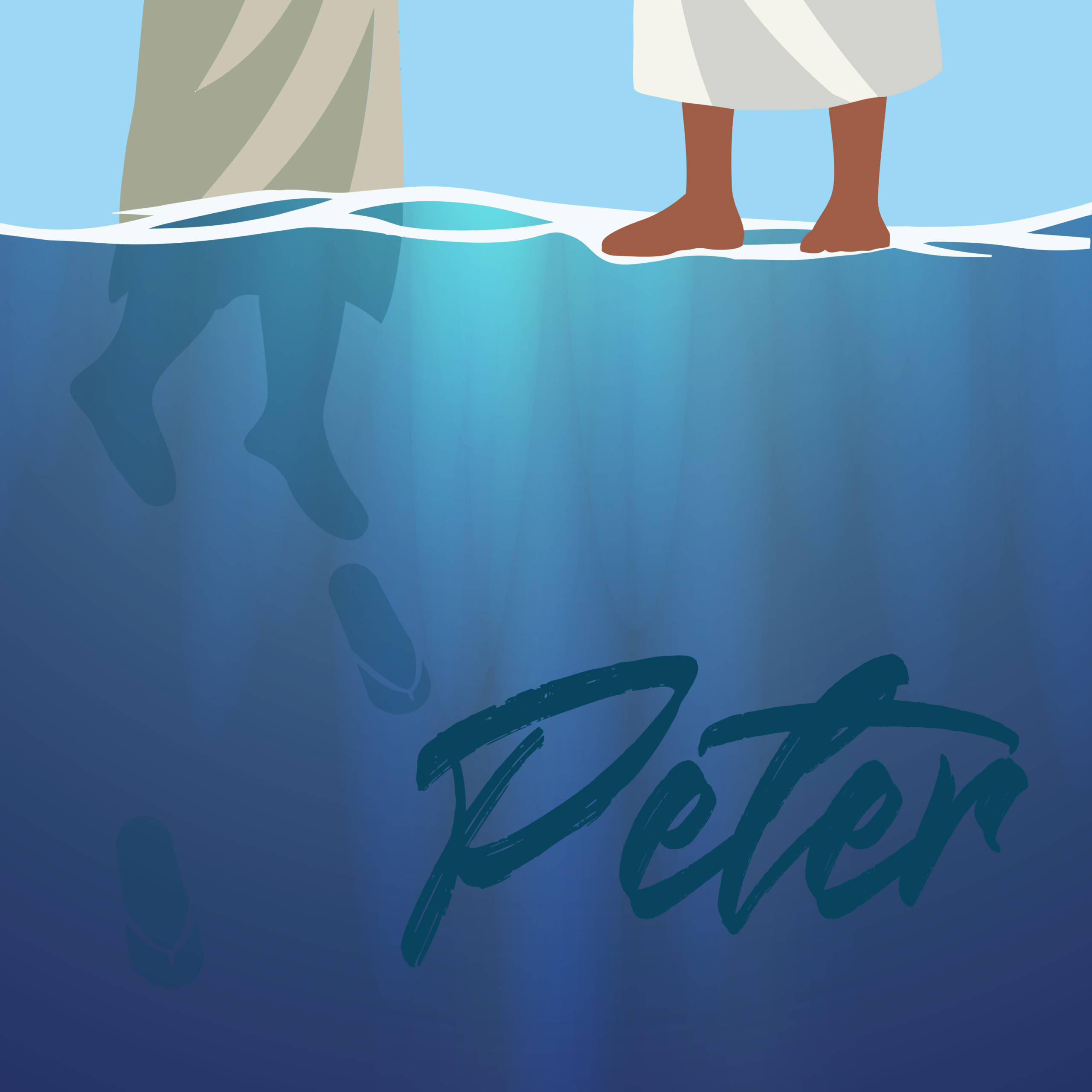
Peter seems to be bold in the ways that he interacts with Jesus and, in turn, sees and experiences things outside those of the other disciples. Peter chooses to brave these “unknowns” in stepping out of the boat, being named the “rock” on which the church would be built, finding new ways of seeing love, and even in doubt, building a solid faith that can withstand life’s curveballs.
Peter showcases bold faith and a never-give-up attitude even when he gets it wrong. This can be a great reminder for youth and leaders that we don’t always get it right. However, through grace and love, God, through Jesus, often shows us ways forward to gain new insights in moments that feel like failure, confusion, or unease.
Details:
$75.00
Week 1—Take the Step
What happens within us when trust calls us to step into something new, something unknown, and even a little scary? Taking those first steps invites us into a deeper relationship with both ourselves and the divine. In this week’s disorienting dilemma, youth will be blindfolded and guided only by the voice of another youth through a “gauntlet,” practicing trust in a tangible way. It echoes the moment when Peter steps out of the boat and onto the water, trusting that Jesus is with him just as much as if he had stayed where it felt safe.
The goal of this lesson is that both youth and leaders will see themselves in Peter’s story and reflect on their own lives. Where are we being invited to step into trust? Where have we already taken brave steps without knowing the outcome? Holding doubt and trust side by side, as Peter does, can help us recognize that even in uncertainty, we are learning to trust not only God, but also the relationships we are building within our community of faith.
Scripture—Matthew 14:22-33
Week 2—Answer the Question
Peter seems to want to give the “right” answer culturally about who Jesus is, and students can learn a lot from this passage for their own descriptors as well. It might be easy to call someone a child of blank or a student or teacher, but find it more difficult to ask the question, “Who do I say that I am, or who does God say that I am? The hope through this disorienting dilemma and in reading the sacred text is that students find resonance with Peter in the context of their own lives as well, and perhaps walk away with a greater perspective or deeper understanding of themselves in the process. These are maps that they can return to again and again as a sort of anchor when they lose their footing of who they are or hear the words of society’s label on them louder than that of their own heart or that of God’s heart.
Scripture—Matthew 16:13–20
Week 3—Be in the Moment
Week 3: Be in the Moment, Matthew 17:1–8
Week 4: Try Again, John 21:15–19
Light and shadow can trick our brains into seeing things differently than we would in full light, or even as our eyes slowly adjust to a dark room. This week’s disorientation’s goal is to draw us into a contemplative state, noticing the way light moves through a space and sitting with the questions that stillness invites.
Peter encounters something similar in this week’s text. On the mountaintop, he experiences Jesus and the divine in a wholly new way—a moment so filled with awe that he wants to freeze it, to stay there and never return to ordinary life. But that’s precisely the hope of this lesson: we need moments that stop us in our tracks. Moments that invite us to see something new, something shifting, something that takes our breath away. The question then becomes this: how do we carry what we’ve seen back into our everyday lives?
Scripture—Matthew 17:1-8
Week 4—Try Again
We all have moments when faith feels distant, when the mountaintop experiences of camp, a mission trip, or a season of deep immersion in the presence of God seem like a distant memory, and we can only see what is right in front of us. In those moments, like Peter in his denial, fear or social pressure crowds out what we know to be true, and we say or do something we regret. We forget, even briefly, that we are the beloved of God. We miss the mark. And yet these stories remind us that we are not alone in that. Peter’s failure is not the end of his story, and ours is not the end of ours. God still speaks over us: you are good, you are holy, you are seen and loved. May these scriptures be a reminder that Christ shows up not only in our mountaintop moments but also in our most human ones, with us and for us, even when we have forgotten who we are.
Scripture—John 21:15-19
Holy Disruptions series are designed to delve into the unique experiences of today’s youth, spark deep theological reflection, and foster transformative discussions. Our three-part methodology empowers students to align with God’s vision and desires for the world.
Facilitate a disorienting experience – where students are most receptive to growth.
Invite students to investigate their reaction to the disorienting moment.
Ask students to explore what God says about it.
Subscribe to receive a monthly roundup of fresh insights and free tools for senior ministry leaders.